Case Studies
When Technical Specialists embraced Strategic Leadership, in a heavily regulated environment
Executive Summary
The issue
A community of 24 technical specialists — brilliant analysts but reluctant leaders — were obliged to step up into a larger leadership role across a large organization. This meant managing risk and uncertainty, leading change and providing implementation oversight on policy and strategy initiatives at corporate and business unit levels. Many felt exposed, unprepared, and afraid of losing personal and team reputations through having their leadership weaknesses in these areas being found out.
How we helped
Step 1 Resolve Within 4 weeks - and with the team's buy-in and consent - we used our diagnostics and a proven approach to establish a (low effort) effective system to identify and handle their key risks and uncertainties. This fixed their exposure to loss of reputation at senior levels (e.g. ExCo).
Step2 Masterclass We led these professionals through a highly focused Deep Dive on what we'd established and why, and how to leverage their new capability.
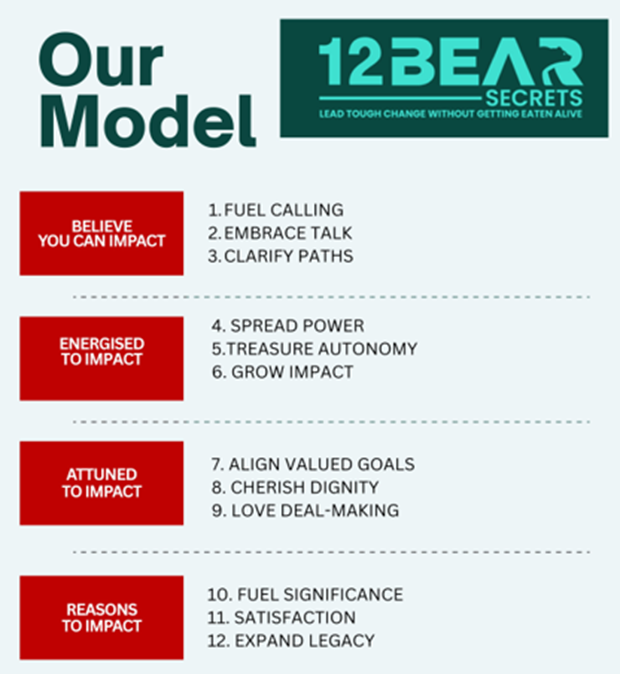
Step 3 Capability. We drew on Bear Secret 1 (Fuel Calling) to go deeper and help them to confront the identity gap that we found had held them back from success in this area (e.g. how to deal with corporate processes that did not work for them, how to create and operate an approach that was effective for them).
Outcome
Within eight weeks, all teams had designed and were operating effective ways to lead through uncertainty and risk, regaining confidence and unlocking new levels of influence across their organisation. Demand for their expertise surged, reputations rose, and risk-informed results accelerated.
Case Study #1
From: 'We deliver great
analysis'
To: 'We inspire, lead and enable breakthrough results through our great analysis'
Rebuilding Trust and Results
Executive Summary
The issue
A flagship digital transformation team — expensive, highly skilled, and business critical — was in danger of collapsing under conflict, silos, and resignations.
How we helped
Step 1 Resolve
With the team's consent, we used individual and team ('Adaptability Quotient' and 'Scared So What') Diagnostics to identify and measure the hidden dynamics undermining individual and team delivery and performance: unequal status, confusion, doubts, uncertainties and distrust.
Step 2 Masterclass
Within four weeks, we'd analyzed and presented our 'measures' findings to the team in a 2 hour Debrief & Q&A and followed this up with confidential debriefs with each individual in the team. This was under Chatham House Rules (to anonymize the sources of comments). The measures and interview comments were met with team approval and became part of the evidence base for further internal action.
Step 3 Capability
This was a short burst of upskilling using Bear Secret 2 (Embrace Talk) to leverage gossip, criticism and doubt to drive individual and team success in leading yourself and influencing others.
Outcome
Within 12 weeks the team had shifted from distress to healthy pressure, stabilized performance, and re‑committed key talent who had been on the verge of quitting. A critical digital investment was protected, and the team adopted some shared language and concepts that permanently shifted their experience of trust, collaboration and business outcomes.
Case Study #2
From: 'I'm struggling to keep my best people in the game'
To: 'I know exactly how to lead my team without burning them out - and in ways I can sustain'
Creating Clarity in Crisis
Executive Summary
The issue
A vital procurement was running late, threatening customer service, business continuity, financial stability, IT security and the team's and organization's credibility with high profile stakeholders. The team who would operate the procured capability were faced with a critical uncertainty: prepare for the incumbent supplier or brace for a disruptive new one? If the incumbent won there would be some routine updates to assure service continuity. But if a radical new supplier was appointed there may not be enough time time to implement all that was necessary, to deadline. Time was running out and the team lacked clarity on which way to jump: what to prepare for.
How we helped
Step 1 Resolve
We led rapid action scenarios work (using our version of the Oxford Scenarios Approach). Within 3 days we had provided the team with the vital elements that lay on a stress-tested path to their goal to deadline, whatever scenario unfolded in reality. This meant they could get on with 'guaranteed' tasks that lay ahead. This is how they redeemed time.
We combined Step 2 Masterclass and Step 3 Capability We provided a 3 hour session (with breaks) to explain how we'd cut through confusion and stress using Bear Secret 3 (Clarify Paths). This was followed up with a 4 hour skills practice session and ongoing check-in support.
Outcome
The senior leader and their team (experts in their finance function and respected leaders in the banking industry) felt that they'd regained control of what their priorities had to be in the situation. Frustration and stress reduced across the team (and for the high profile stakeholders dependent on the success of this procuremnet.. The winning bid came from a highly disruptive supplier — yet the team delivered a successful implementation on time, avoided burnout, and strengthened their leadership skills in handling uncertainty under pressure. This raised their individual and team reputations at corporate level.
Case Study #3
From: 'We're getting stuck - and running out of time'
To: 'We used a proven technique to gain time - and met our deadline'
From Referees to Leaders
Executive Summary
The issue
A high‑performing Finance Leadership Group were being pushed far outside their comfort zone, asked to lead unfamiliar ESG, tech, and regulatory reform with aggressive timelines and intense scrutiny from senior leaders and external stakehoders. Their historic “financial referee” identities no longer worked — they were now expected to be goal‑scorers not just enforcers of rules.
How we helped
Step 1 Resolve
Within 6 weeks we identified and acted on closing key gaps in trust and credibility with key stakeholders (the FDs' own staff and key internal customers of the FDs. It was vital to earned trust for leadership (we did this through providing several 'quick wins' for stakeholders by producing several useful, easy to use (integrated) decision support reports that the FDs had not been able to provide up until that time (for whatever reason).
Step 2 Masterclass
Using quantitative and qualitative diagnostic data (for individuals and the team of 14 individuals, and paying attention to indvidual demographic factors and preferences) we identified and measured gaps in capability where the Finance Directors were likely to struggle to adapt to user requests. We provided four short Masterclasses to close the key gaps. One of these gaps was a tendency to micromanage when under pressure on unfamiliar subject matter. These sessions brought immediate help where FD team members and internal customers were resisting change leadership by the FDs because (as it turned out) the FDs had not earned the trust and confidence of these stakeholders.
Step 3 Capability
We drew on the principles in Bear Secret 4 (Spread Power) to help individual FDs and their team members to shift identity, build adaptability, and embrace expanded leadership roles. This meant roleplay/simulation practice with 'difficult' stakeholders, applying different ways of sharing and expanding power in challenging situations.
Outcomes
By being open to improving their power-sharing skills, within 14 weeks, over half of the FDs accelerated their leadership reputation and trust with stakeholders which saved them, their customers and their organization time and money. Some FDs retreated into their traditional and (somewhat outdated) roles. The team’s future split along one line: those who adapted thrived and fuelled organisational success, those who didn’t are probably about to become “perfectly suited for a world that no longer exists.”
Case Study #4
From: 'We're just surviving this project'
To: 'We're leveraging this challenge to accelerate our reputations and careers'
Breaking a Career Ceiling
Executive Summary
The issue
A high‑performing Finance Director (FD) felt ready for a CFO role — but for some strange reason no one else saw her that way. She was getting pigeon‑holed, as a great technician, and getting sucked into a career crisis that was affecting her energy, confidence and credibility.
How we helped
We combined Steps 1 Resolve, 2 Masterclass and 3 Capability
Using our diagnostics and Bear Secret 5 (Treasure Autonomy) we helped this FD to expand her vision of what sort of leader she could be. We provided the research ansd true stories on why and how to back-off on her tendency to micro-manage people. We coached her (using our own proven models) on how to envision herself as both an influential CFO leader influencer and a top CFO with innovative technical skills.
Outcome
Within 7 monhs this FD secured a desirable CFO role in another organization. She continues to grow her influence using the 12 Bear Secrets.
Case Study #5
From: 'I can’t help but micro-manage people. I’d love to trust them, but I just can’t take that risk'
To: 'I’ve found ways to align my people for powerful results. Our reputation is up and my stress is down'
When a Resource Crisis Became a Breakthrough in Frontline Impact
Executive Summary
The Issue
A Senior Business Change Manager was expected to deliver major operational benefits without additional budget, resources, or authority. The organisation’s norms were making the situation worse, not better.
How we helped
We combined Step 1 Resolve and Step 2 Masterclass
Using AQ SWOT analyses and Bear Secret 6 (Grow Impact- especially frontline impact), we built, presented and gained buy-in for a case to innovate how the Business Change between the Senior Business Change Manager and their team, their Business Unit Senior Leadership Team and the national Business Change leadership team could work more effectively for staff and customers in this situation. We gained corporate approval at national level for this approach, in this situation.
Step 3 Capability
We held five Masterclasses (with relevant parties) over 4 months which helped them to shift beliefs, unlock creativity, and redesign operational roles and deals.
Outcome
Over 6 months the Business Unit gained a step-change in benefits going on to make nearly 20% more net cash benefits than the Business Case target over the next two years, worth many millions — with no extra budget. What looked like a resource problem was actually an impact and innovation problem, solved through reframed identity, creativity, and frontline ownership.
Case Study #6
From: 'I don’t have the resources I need to succeed'
To: 'I know exactly how to optimize what I have for great impact'
Multiplying Leadership Impact
Executive Summary
The issue
A highly experienced Programme Manager was delivering a major transformation in a fast‑growing international company. Processes were in place, benefits were flowing — but not on the scale needed. Something was missing. The team had more potential, more ideas, more tacit knowledge… but they weren’t bringing it forward.
How we helped
We combined Step 1 Resolve, Step 2 Masterclass and Step 3 Capability
Diagnostics revealed the hidden blocker: talented change professionals were unsure what kind of leaders they were “allowed” to be. Using diagnostics and Bear Secret 7 (Align Valued Goals) the Programme Manager created space for leadership growth, autonomy, and impact without increasing headcount.
Outcome
A step-change in benefits realization emerged over 9 months and new leaders emerged who multiplied their impact in the programmes and projects they joined after this Programme.
Case Study #7
From: 'Every project feels like a pressure cooker. My top talent is stressed and eyeing the exit'
To: 'I know exactly how to lead my team without burning them out'
Turning Conflict into Influence
Executive Summary
The issue
A newly appointed COO entered a fast‑growing, post‑acquisition organisation and immediately encountered cultural clashes, operational friction, and a hostile confrontation from a senior leadership team frustrated by delays on key goals that they had caused themselves.
How we helped
We combined Step 1 Resolve, Step 2 Masterclass and Step 3 Capability
Using our diagnostics and Bear Secret 8 (Cherish Dignity) we helped the COO and his team to decode the emotional drivers behind the conflict, restore dignity between the COO his team and their senior leaders.
Outcome
Within 5 months, the COO and his team were able to build trust and create new alliances with the Senior Leadership Team. What began as a reputational threat became a defining leadership success — and a repeatable influencing skills which the COO and his team members were able to carry into their future roles.
Case Study #8
From: 'I’m not just doing my job anymore. I’m firefighting, dealing with resistance, and trying to keep everything from falling apart'
To: 'I have a strategic game plan… and it’s working for me'
Stabilizing a Strategic Partnership
Executive Summary
The issue
A profitable UK family‑run firm had become dangerously dependent on a single Strategic Partner — and that Partner appeared to be in financial trouble. The client feared being pulled under if the Partner collapsed.
How we helped
Step 1 Resolve
Using our diagnostics and Bear Secret 9 (Love Deal-Making) we consulted representatives from both both organizations. This uncovered governance, leadership, and motivation issues that were masquerading as financial distress. We applied a few simple but powerful tools to stabilize and clarify the relationships, roles and responsibilities and performance between the organizations.
We combined Step 2 Masterclass and Step 3 Capability Through a series of debriefs over four weeks, the rebuild and clarification of relationships, roles and responsibilities and service performance agreements were socialised and made familiar to key people involved in both organizations.
Outcome
Within four months both parties built a modernised partnership. What looked like a looming financial crisis became a breakthrough in stability, trust, and longer‑term resilience for those involved.
Case Study #9
From: 'Help! Our Strategic Partner is failing'
To: 'We’ve come through this crisis well and have eliminated key issues for greater stability and less risk'
Reigniting Organizational Identity
Executive Summary
The issue
A respected UK membership organisation was losing relevance fast. New competitors were taking market share, members were disengaging, and the organisation was heading toward bankruptcy. Organization leaders appeared stuck in nostalgia, resting on past victories instead of confronting present realities.
How we helped
We combined Step 1 Resolve and Step 2 Masterclass
Using Bear Secret 10 (Fuel Significance), we exposed key strategic blind spots that were undermining the senior leaders' confidence, direction and action to compete with new entrants. We worked with the CEO and their team to co-design an Action Plan to refresh and apply their strengths.
Step 3 Capability
We supported the Senior Leadership Team of five as they rebuilt their organisational identity, and crafted a modern, compelling value proposition.
Outcome
Within five months, the SLT reinvented their organization, regaining confidence and returning to market relevance. This transformed a crisis into a strategic rebirth.
Case Study #10
From: 'We’re failing to compete'
To: 'We have a strategic game plan… and it’s working'
Leading Through Permanent Constraint
Executive Summary
The issue
A seasoned global Programme Manager was experiencing pressure to deliver more impact with fewer resources — permanently. Stress in his team was rising, top performers including key projects managers (contractors) were disengaging, and burnout risk was escalating.
How we helped
We combined Step 1 Resolve, Step 2 Masterclass and Step 3 Capability
Using our diagnostics and Bear Secret 11 (Satisfaction) we used some practical, enjoyable Masterclasses to help the leader and his team (working with key stakeholders) to simplify processes, rebalance the pressures on people and delivery and create clarity in a volatile and hostile work environment.
Outcome
The team were able to discover and play to their strengths. They also worked to become more adaptable. Over the course of 12 weeks they experienced lower stress, higher engagement, and motivation, stabilized talent retention and leaders and staff who were able to operate with more confidence and calm in their permanently constrained world.
Case Study #11
From: 'I’m being held accountable for tough results, but my budget and resources aren’t keeping up'
To: 'I know exactly how to optimize what I have for great impact'
Delivering Strategic impact
Executive Summary
The issue
A technically strong female leader in a global medical charity was experincing a slowing in delivery and impact. Their strategic impact wasn’t landing, their confidence was fading and they were under increasing pressure from financial stakeholders to test a major organizational goal for feasibility.
How we helped
We combined Step 1 Resolve, Step 2 Masterclass and Step 3 Capability
Using our diagnostics and Bear Secret 12 (Expand Legacy) we helped the leader to discover and respond to limiting beliefs in their charity, to expand strategic thinking internally and with key stakeholders and to build deeper more supportive executive‑level behaviors.
Outcome
Within two weeks of dedicated attention, the organization gained clarity on the feasibility of its strategic goal - and the leader gained renewed momentum, confidence, and a clear path toward their senior leadership role that was more personally sustainable.
Case Study #12
From: 'Can I rely on this plan?'
To: 'I can see great results emerging already'